
Change That Scales: Building a Repeatable System, Not Just a Strategy
How top-performing organizations build change capabilities that evolve with their business.

Here's a frustrating truth: We keep reinventing change. I've watched countless companies attack each transformation like it's the first time anyone's ever attempted it—creating fresh plans, assigning new teams, and draining precious organizational energy. The secret to lasting transformation isn't just a strong strategy; it's building a system that can be replicated, scaled, and embedded throughout your organization.
BLUF (Bottom Line Up Front):
🔄 Sustainable change requires a system, not just individual strategies.
🏗️ Organizations that build repeatable processes see better adoption rates.
🚀 Scalable change focuses on capabilities, not just completing initiatives.
⚙️ Well-designed systems reduce resistance and accelerate implementation.
The Problem With "One-and-Done" Change Initiatives
When your organization launches a change effort—whether it's implementing new technology, restructuring teams, or shifting strategy—do you find yourself essentially starting from scratch each time?
You're not alone. Most organizations treat each transformation as a unique project, rebuilding the approach, materials, and processes with every new initiative. This creates three significant problems:
Inconsistent results: Without standardized approaches, outcomes vary wildly across departments and initiatives
Wasted resources: Teams spend precious time recreating processes that could be reused
Change fatigue: Without systematic learning, the same mistakes get repeated, exhausting your people
The organizations that excel at change don't just execute individual strategies—they build change as a competitive advantage through repeatable, scalable systems.
Four Elements of Scalable Change Systems
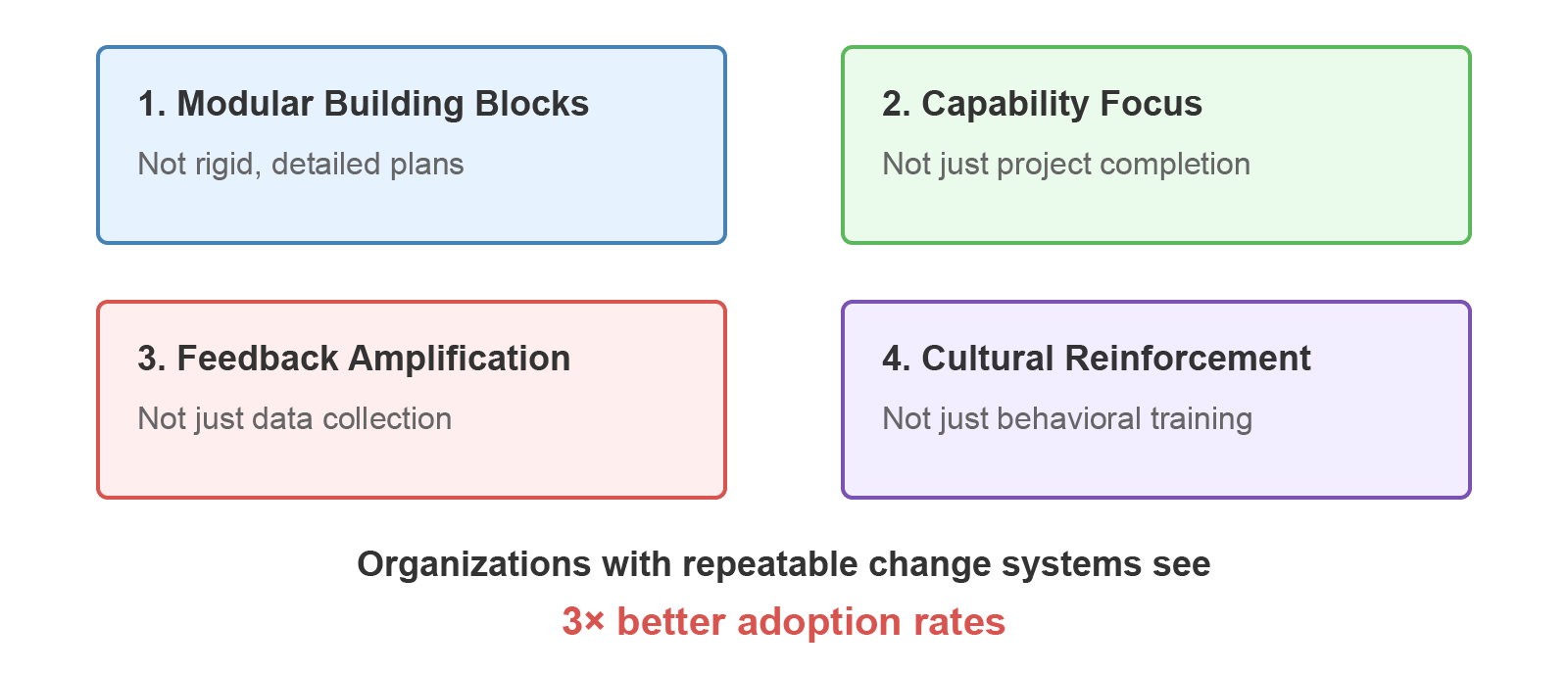
Organizations that consistently succeed at change have built standardized, flexible frameworks that evolve with their business needs. Here's what makes those systems work:
1. Modular Building Blocks, Not Rigid Plans
Traditional approach: Detailed many-month change plans that are outdated within weeks
Scalable approach: Core building blocks that can be assembled to fit each initiative's needs
What it looks like in practice:
Communication templates that can be customized for different audiences
Training modules that can be mixed and matched for different roles
Feedback mechanisms that work across different types of changes
Ask yourself: Do we recreate every communication plan from scratch, or do we have templates and approaches we can quickly adapt?
2. Capability Focus, Not Just Project Completion
Traditional approach: Success measured by project completion dates
Scalable approach: Success measured by capability building and knowledge transfer
What it looks like in practice:
Change leaders who train others as they implement
Implementation guides that capture learnings for future initiatives
Cross-functional change networks that share best practices
Ask yourself: After completing a change initiative, is your organization more capable of handling the next one?
3. Feedback Amplification, Not Just Collection
Traditional approach: Surveys that gather data but rarely drive meaningful adjustments
Scalable approach: Real-time feedback loops that inform immediate course corrections
What it looks like in practice:
Pulse check systems that flag adoption issues early
Regular feedback sessions with implementers and end users
Dashboards that highlight resistance patterns across the organization
Ask yourself: How quickly can you identify when a change isn't working, and how rapidly can you adjust?
4. Cultural Reinforcement, Not Just Behavioral Training
Traditional approach: Training on new behaviors without addressing underlying mindsets
Scalable approach: Alignment of systems, incentives, and leadership behaviors with desired change
What it looks like in practice:
Recognition programs that highlight change adoption
Performance metrics that include change implementation capabilities
Leadership development that builds change leadership skills at all levels
Ask yourself: Do your organizational systems and culture support or undermine your change efforts?
Building Your Repeatable Change System
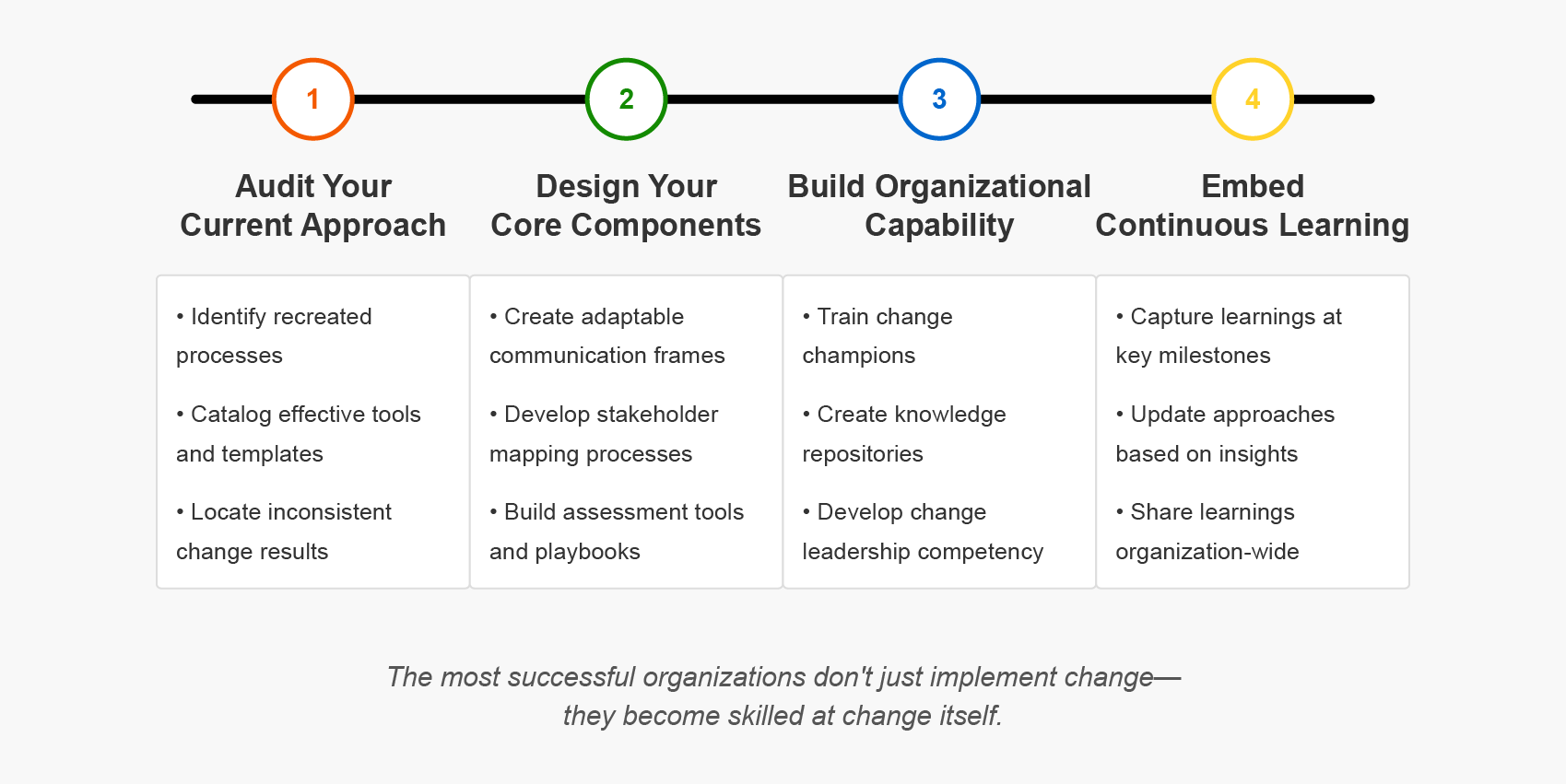
Here's how to start creating a change system that scales with your organization:
Step 1: Audit Your Current Approach
What elements of your change process are you recreating every time?
Which tools, templates, or approaches have proven effective across multiple initiatives?
Where do you see the most inconsistency in change results?
Step 2: Design Your Core Components
Communication frameworks that can be customized for any initiative
Stakeholder mapping and engagement processes
Change impact assessment tools
Resistance management playbooks
Step 3: Build Organizational Capability
Identify and train a network of change champions across departments
Create knowledge repositories that capture learnings from each initiative
Develop change leadership as a core competency for all managers
Step 4: Embed Continuous Learning
After each major change milestone, capture what worked and what didn't
Regularly update your approach based on these insights
Share learnings across the organization to prevent repeated mistakes
The most successful organizations don't just implement change—they become skilled at change itself.
This Week's Challenge
Take these three steps to begin building your repeatable change system:
Identify one change tool or template that your organization has successfully used multiple times. How could you formalize and scale it?
Find one repeating pain point in your change processes. What system could you design to address it consistently?
Pick one recent change initiative and document the lessons learned that could be applied to future efforts.
Reply
or
with your biggest insight. What's one aspect of your change approach that could be systematized for greater scale and consistency?

Miguel Guevara
📞 Book a 1:1 Planning call with me (Miguel)
👀 Follow me (Miguel) on LinkedIn